What ServiceNow Costs Mid-Market IT Teams (And Why Most Overpay)
Category
Service Management
Uncategorized
.svg)
Category
ServiceNow pricing for mid-market companies follows a predictable pattern: the license number you see in the sales conversation is not the number you'll write checks for over the next three years. For mid-market IT teams, companies with 500 to 5,000 employees, the total cost of owning ServiceNow is typically three to five times the annual license fee, and most IT Directors don't discover that until they're deep into implementation.
I spent years inside the ServiceNow ecosystem before building Servicely. I've seen the commercial side of these deals from both directions. This post breaks down what mid-market companies actually pay, why the true cost is so much higher than the quoted license, and what the alternatives look like when you run the numbers honestly.
If you're heading into a renewal conversation or evaluating ServiceNow for the first time, read this before you get on the phone with your rep.
ServiceNow does not publish its pricing. There is no pricing page. No tier list. No publicly available rate card. If you want to know what ServiceNow costs, you have to talk to a sales representative who is trained to qualify your budget before revealing numbers.
That opacity is not an accident. It's a deliberate commercial strategy that benefits enterprise buyers with dedicated procurement teams and experienced negotiators, and it disadvantages mid-market IT Directors who buy software once every few years and don't know what leverage looks like.
Enterprise companies with seven-figure IT budgets and legal teams know how to play the ServiceNow sales process. They know to bring in a third-party benchmarking firm, negotiate multi-year terms, and push back on module bundling. Mid-market companies rarely have that infrastructure. Most IT Directors at a 1,500-person company handle the ServiceNow negotiation themselves, alongside their day jobs.
The result is that two companies with identical use cases, 50 fulfillers, ITSM and ITAM modules, US-based deployment, can easily be paying annual fees that differ by 30 to 50%. The platform's own sales team will acknowledge that this is "negotiation-dependent" if you ask them directly. What they won't volunteer is how much room there is in their pricing model and exactly which arguments move the number.
ServiceNow's 2025 annual results reported $12.8 billion in subscription revenues across approximately 8,700 customers. Do the math, and the average contract is around $1.47 million per year. The platform is not architected for a company writing a $150,000 check; it's architected for the customer writing a $1.5 million check who can afford to operate it accordingly.
Since ServiceNow won't publish pricing, the industry has built up a reasonably reliable body of third-party estimates from procurement data firms, customer disclosures, and vendor comparisons. Here's what those estimates consistently show for ITSM licensing alone:
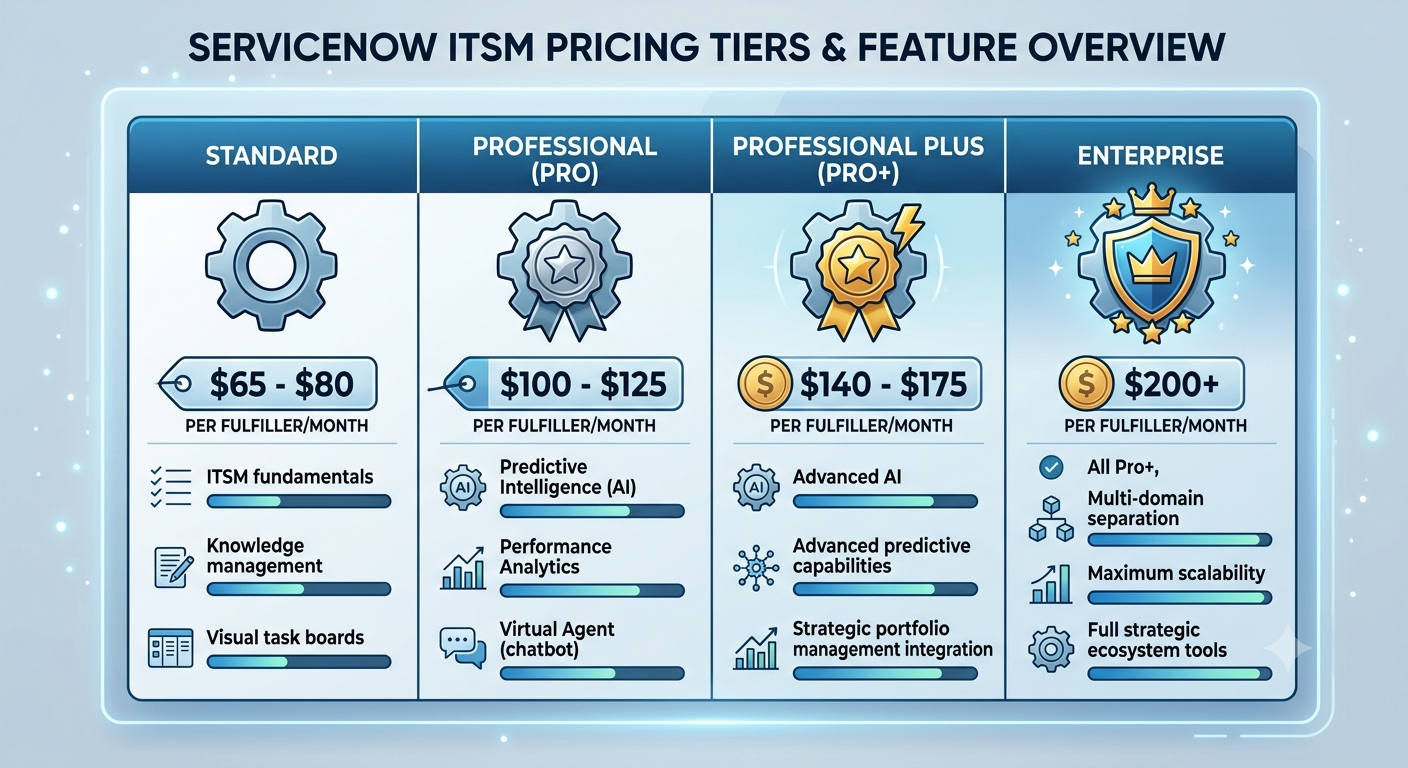
These are licensing costs for a single module. Most mid-market deployments don't run on ITSM alone.
For a typical 50-fulfiller mid-market organization running ITSM Professional, licensing alone runs approximately $96,000 per year at the $160 rate. That number looks manageable. What happens next is where mid-market teams get surprised.
Module stacking changes everything. ITSM, IT Asset Management (ITAM), Configuration Management Database (CMDB), and HR Service Delivery are each licensed separately. A company that buys ITSM Professional and then adds ITAM does not pay the ITSM rate for those modules; each carries its own per-module pricing. A realistic mid-market deployment with ITSM + ITAM can push license costs to $150,000-$250,000 per year before the first consultant is engaged.
According to published benchmarks from NowTribe and cost analysis from Vendr's procurement database, mid-market organizations with 50 fulfillers face annual licensing costs of $150,000 to $400,000, depending on module selection and negotiation leverage. That range is wide because the negotiation matters enormously, and mid-market buyers typically lack the leverage to reach the low end of it.
The license fee is the amount listed in the contract. The number you actually pay over three years is built from three other line items that most mid-market IT teams don't fully model until they're already committed.
Here's what the ServiceNow partner ecosystem won't tell you upfront: the professional services market around ServiceNow is approximately five times the size of the software licensing market. For every dollar spent on ServiceNow licenses, the ecosystem generates roughly five dollars in consulting fees across Deloitte, KPMG, Accenture, and hundreds of certified ServiceNow implementation partners.
That ratio reflects the platform's architecture. ServiceNow is configurable but not self-service. Meaningful workflow changes, a new approval chain, a modified SLA structure, and a custom escalation path require a certified ServiceNow developer or a platform-specialist admin. The platform's power comes from its configurability, and that configurability requires specialized knowledge to access.
For mid-market companies, this creates a structural problem. You're not just paying for software. You're entering a dependency relationship with a consulting ecosystem that bills at $200 to $350 per hour for certified ServiceNow resources. Every time your business changes- a new department onboarded, an acquisition, a regulatory requirement, a team reorganization- your ServiceNow instance needs expert attention.
NowTribe's analysis puts the implementation cost alone at three to five times the annual license fee. A $150,000 annual license, therefore, implies $450,000 to $750,000 in implementation costs for the initial deployment, before the first production ticket is closed.
ServiceNow's licensing model is deliberately modular, which sounds like a benefit (pay only for what you use) but in practice functions as a cost escalator. When you start with ITSM and later need ITAM, you buy another module. When your HR team sees what IT is doing and wants service management for employee onboarding, that's HR Service Delivery, another separate license.
Each module purchase triggers its own implementation work, which triggers its own consulting engagement. The platform is designed for comprehensive adoption, which means the business case for each additional module is always reasonable on its own terms, even as the cumulative bill keeps climbing.
ServiceNow operates on a twice-yearly major release cycle. Each release, Vancouver, Washington DC, Xanadu, brings new features but also requires compatibility testing, customization review, and often remediation work on any custom configurations your team has built. For large enterprises with dedicated ServiceNow teams, this is manageable overhead. For mid-market companies where one or two admins handle ServiceNow alongside their other responsibilities, each upgrade cycle requires weeks of focused effort.
The Now Assist AI add-on adds a further dimension: to access ServiceNow's AI capabilities, you move to Pro Plus, which carries that 50 to 60% premium over the base Professional tier. For a 50-fulfiller organization already paying $96,000 per year on ITSM Professional, upgrading to Pro Plus to access AI features adds approximately $54,000 per year before the first AI workflow goes live.
Let's run the actual numbers for a realistic mid-market scenario. Company profile: 1,500 employees, 50 IT fulfillers, deploying ITSM Professional plus ITAM. Three-year view.
ServiceNow, Year 1:
ServiceNow, Year 2:
ServiceNow, Year 3:
Three-Year ServiceNow TCO: approximately $1,094,000
This is consistent with real customer data we see at Servicely. One of our customers was paying $562,000 per year all-in on their ServiceNow deployment, licenses plus the consulting and admin overhead required to keep the platform running. The same scope of ITSM and ITAM capability now costs them $120,000 per year on Servicely, with no external consultants required for workflow changes.
That's a 73% reduction in platform cost. Not through cutting capability, but through eliminating the consultant dependency that ServiceNow's architecture requires and that Servicely's AI configuration removes.
Want to see what your specific ServiceNow replacement would cost? Book a 30-minute pricing comparison call; we'll model your actual numbers, not industry averages.
Book a Pricing Comparison Call
Mid-market IT teams evaluating ServiceNow alternatives typically narrow to three platforms: Freshservice, Jira Service Management, and Servicely. Here's an honest comparison, including what each gets right and where the trade-offs are.
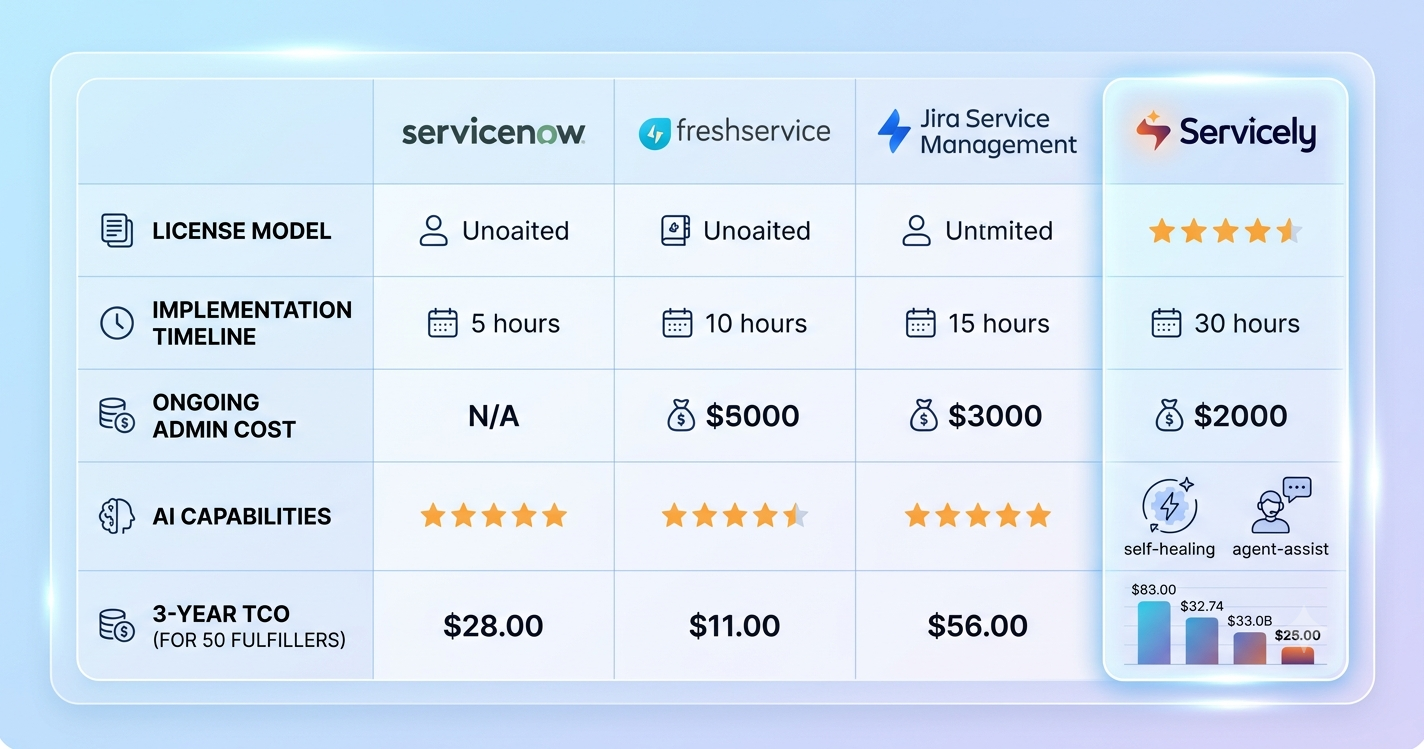
Freshservice: Freshservice is the default mid-market incumbent, and for good reason: it's straightforward to deploy, the UI is clean, and the entry-level pricing is genuinely lower than ServiceNow's. The problem is that Freshservice's pricing model mirrors ServiceNow's modular escalation pattern once you start adding capabilities. IT Asset Management, IT Operations Management, and advanced analytics are separate add-ons. Once you've assembled the full feature set that a 1,500-person company actually needs, Freshservice's total cost is often not materially different from ServiceNow's. And on AI capabilities, Freshservice's Freddy AI is a bolt-on layer; it was not architected into the platform from the start, which limits what it can do and how it integrates with workflows.
Jira Service Management: Jira SM is the right choice if your IT team operates within the Atlassian ecosystem and your primary use case is developer-adjacent IT support. The pricing is transparent, with published tiers ranging from $17.65 per agent per month (Standard) to $44.27 per agent per month (Premium), and the Atlassian ecosystem integrations are genuine. The trade-off is that Jira SM was built from a developer workflow foundation, not an ITSM foundation. ITIL process depth, CMDB capability, and enterprise-grade SLA management are second-class citizens. It works well for software companies with hybrid Dev/IT teams. It's the wrong platform for a 1,500-person financial services company with serious ITIL process requirements.
Servicely: Servicely was purpose-built for mid-market ITSM, the 2,000 to 20,000 employee range, where ServiceNow is priced beyond reach, and Freshservice lacks the depth required. The AI configuration layer eliminates 90-95% of the consultant dependency that makes ServiceNow expensive to own. ServiceNow admins can configure Servicely workflows themselves, in natural language, without a certified implementation partner. Westcon's team of three ServiceNow admins ran their own Servicely migration. The implementation timeline for a ServiceNow replacement is approximately 12 weeks for a mature ITSM environment. Total cost of ownership, including implementation, runs approximately 73% lower than ServiceNow for equivalent module coverage.
The honest trade-off: Servicely is not the right platform for a 20,000-person enterprise with a dedicated ServiceNow Center of Excellence, 400 custom workflows built over a decade, and a seven-figure IT software budget. For that customer, ServiceNow's depth and the ecosystem supporting it represent genuine value. But if you're a 1,500-person company with one or two admins managing your ITSM platform alongside other responsibilities, you are not that customer, and you are paying enterprise prices for infrastructure you aren't able to fully use.
I built Servicely because I spent years in the ServiceNow ecosystem and watched mid-market companies struggle with a platform not designed for them. But that doesn't mean ServiceNow is the wrong platform for everyone. Let me be direct about where it makes sense.
ServiceNow is genuinely the right platform if:
For those customers, ServiceNow's ecosystem depth, availability of certified talent, and platform maturity are legitimate value-adds that justify the premium. Kaiser Permanente, JPMorgan Chase, and Deloitte are ServiceNow customers for good reasons.
ServiceNow is the wrong platform if:
The tell is the consultant dependency. If your team cannot change an approval workflow or add a new service catalog item without external help, you are not operating the platform; the platform is operating you. That is a mid-market problem, not an enterprise one. Enterprise companies have the internal capacity to manage complex platforms. Mid-market companies often do not.
There is also a specific moment when ServiceNow becomes the wrong choice: when your company decides it needs AI in its ITSM workflow and discovers that the path to Now Assist requires a 50-60% license uplift for capabilities that still run on top of the same 1994-era service management architecture. Bolting AI onto a legacy platform is not the same as building AI into the platform from the start. The architecture matters.
I've done 400+ ServiceNow deployments. I've seen the sales pitch, the implementation scope, and the three-year renewal conversation. The pattern is consistent: mid-market companies sign up for a platform that promises enterprise-grade service management and spend the next three years paying enterprise prices to operate it.
The $562,000-$120,000 comparison we see in our customer data isn't an outlier. It's the expected outcome when a mid-market company pays the full cost of ownership for ServiceNow rather than a platform purpose-built for their scale. The 73% cost reduction isn't marketing copy; it reflects the structural difference between a platform that requires a consulting ecosystem to operate and one that doesn't.
If your IT team is doing the work, you should own the platform. And you should be able to change a workflow on Tuesday morning without a consultant on the phone.
You can read more about the full picture of hidden costs in our post on the real cost of your ITSM platform. If you're ready to see a side-by-side comparison of what switching actually looks like, the Servicely vs ServiceNow comparison page has the full breakdown, including pricing, capabilities, and migration approach.
See the full Servicely vs ServiceNow comparison, including real customer TCO data, a feature-by-feature breakdown, and a migration timeline. Compare Servicely vs ServiceNow
ServiceNow pricing for mid-market organizations typically ranges from $150,000 to $400,000 annually for licensing, depending on modules, user counts, and contract negotiations. However, licensing is only part of the equation. Implementation, customization, consulting, and ongoing administration can significantly increase total ownership costs.
ServiceNow does not publish standard pricing publicly, and contract costs often vary based on negotiation leverage, deployment scope, and module selection. Two mid-market companies with similar requirements can end up paying very different amounts, making it important to evaluate total cost of ownership rather than license fees alone.


