.png)


If your IT team runs on Jira Service Management, October 2024 was the month you probably noticed something missing. Atlassian moved change management, problem management, and advanced incident management out of the Standard plan and into Premium, a tier that runs about $49–$51 per agent per month. For a 20-agent team, that is a $7,500 annual price increase just to keep doing what you were already doing.
That packaging change sparked a real conversation that many IT directors had been avoiding: is JSM actually the right tool for a mid-market IT team, or did we just land on it because the developers were already using Jira?
This post is a fair comparison. I built Servicely, so I am obviously not a neutral party. But I have been in this industry long enough to know that a one-sided hit piece helps no one. JSM is a legitimate tool with real strengths. What I want to do here is give you an honest read on where it works, where it does not, and how to think about the decision if you are sitting on a renewal or evaluating a switch.
What Changed in October 2024, And Why It Matters
On October 16, 2024, Atlassian moved a significant set of ITSM capabilities from JSM Free and Standard to Premium and Enterprise only. The features that moved include:
- Change management: Work category, queues, change calendar, automated risk assessments, CI/CD integrations, and system-level automation rules
- Problem management: Problem work category and problem queues
- Advanced incident management: Conference calls, major incident workflows, post-incident reviews, and chat integration
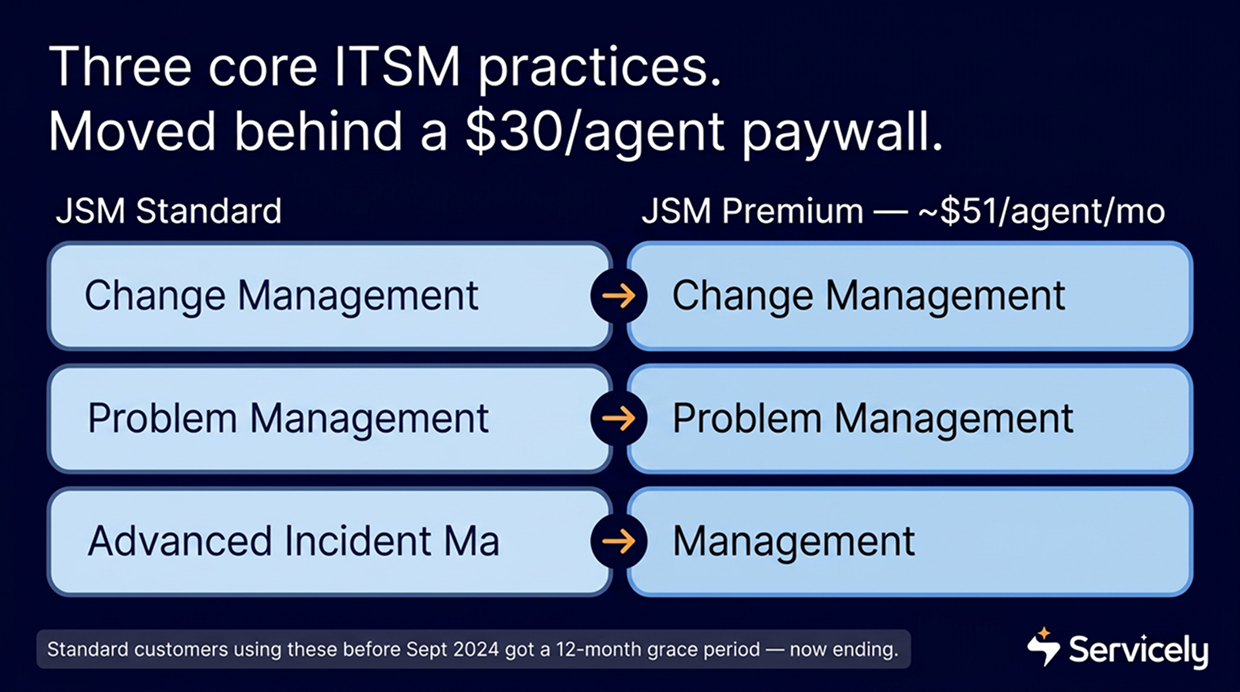
Standard plan customers who had been actively using those features between March and September 2024 received a 12-month grace period before access was revoked. That grace period is now ending for most teams.
Here is why this matters practically. If you are a mid-market IT team running a proper ITIL-aligned service desk, change management and problem management are not optional extras. They are core to how you operate. Moving them to a tier that costs roughly $30 more per agent per month, with no equivalent reduction in what the Standard plan delivers, amounts to a meaningful price increase packaged as a product decision.
Atlassian's reasoning is that Premium includes a broader suite of capabilities (assets/CMDB, AI virtual agent, advanced analytics) and that the feature groupings better reflect how mature ITSM teams work. That is a defensible position. But if you were on Standard specifically because your team does not need assets management or AI virtual agents, you are now paying for capabilities you did not ask for in order to keep the workflows you rely on.
That is the context for this comparison. Not "JSM is bad"; it is not, but rather: what does the real cost picture look like, and is the tool actually built for the way a mid-market IT team operates?
Evaluating your options after the JSM packaging change? Servicely includes change management, problem management, and AI-native automation in a single plan, no tier gymnastics required.
See how it compares for your team size and workflow. See Servicely's ITSM platform
Where JSM Genuinely Excels
Let me start with what Atlassian gets right, because the tool has earned its market position for real reasons.
The developer ecosystem is unmatched. If your organization runs on Atlassian- Jira Software for engineering, Confluence for documentation, Bitbucket for source control- JSM is a natural extension. The integration is native, not an afterthought. Engineers raising incidents can link directly to the Jira issue they are working on. Post-incident reviews can reference the underlying code commit. That tight loop between development and IT operations is genuinely valuable for organizations where the dev and IT teams are closely coupled.
The Atlassian Marketplace is deep. Over 1,000 third-party apps integrate with JSM. If you have a niche workflow requirement, there is probably a marketplace app for it. That extensibility is a real advantage over platforms with smaller ecosystems.
Confluence as a knowledge base works well. Teams that already use Confluence for internal documentation get a near-zero-friction knowledge management integration. End users searching the self-service portal can surface Confluence articles directly. Organizations that have invested in building out their Confluence library can leverage that asset within JSM without requiring a migration effort.
For software companies, the DevOps integration is hard to replicate. JSM's native support for deployment tracking, CI/CD pipeline visibility, and change risk tied to deployment history makes it a strong choice for IT teams at software companies. If your change advisory board needs to review deploys alongside service incidents, JSM handles that better than most alternatives.
The Standard tier price point is competitive. At approximately $20 per agent per month (annual), JSM Standard is genuinely affordable for basic incident management and request fulfillment. If your requirements are limited to those workflows, the price-to-capability ratio is reasonable.
Where JSM Struggles For Mid-Market IT Teams
The honest answer is that JSM was built for software development organizations and then extended to handle IT service management. That origin matters, and it shows up in specific ways for mid-market IT teams who are not primarily managing software engineers.
The interface assumes Jira familiarity. For a development team that lives in Jira Software, the JSM interface feels natural. For an IT team where agents are not software engineers- your service desk staff, your endpoint technicians, your operations people- the Jira mental model creates friction. The concept of projects, issue types, and schemes requires configuration knowledge that most IT teams do not have in-house. What takes 15 minutes in purpose-built ITSM tools often takes a Jira admin and an afternoon in JSM.
ITSM capability depth requires Premium. After the October 2024 packaging change, a proper ITIL-aligned IT team needs Premium. That means $49–$51 per agent per month. The Standard plan ($20/agent/month) no longer supports change or problem management, the two processes that separate a proper service management operation from a ticketing system.
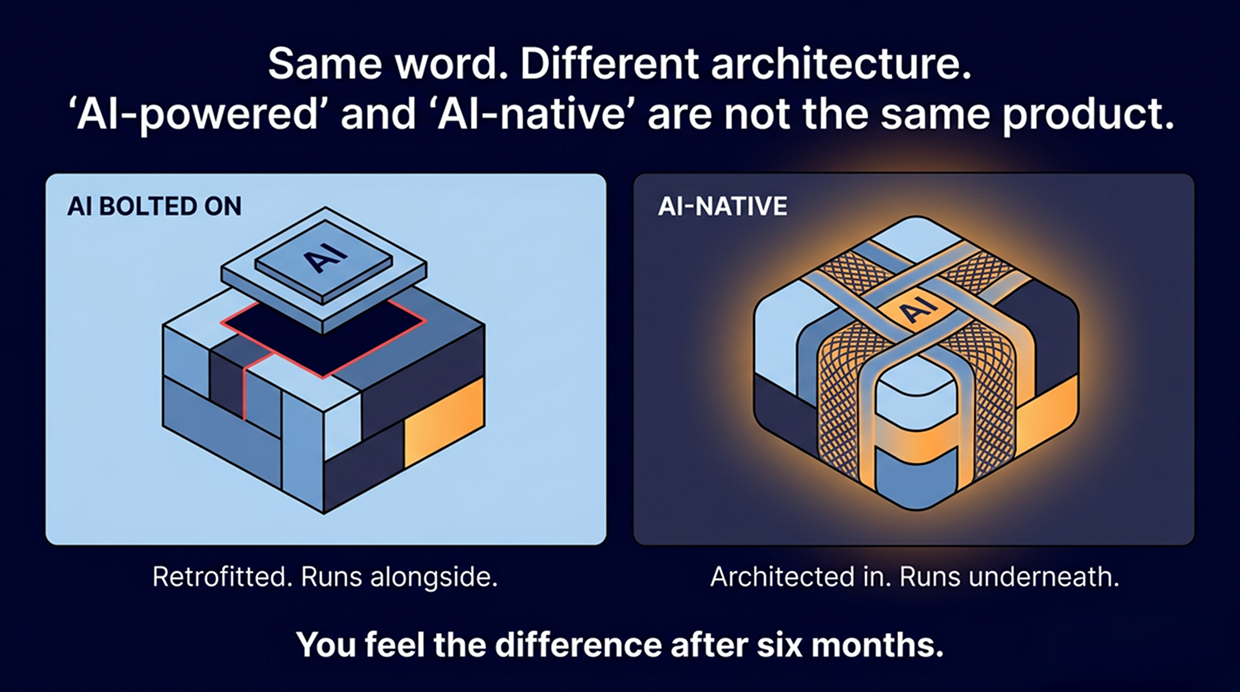
AI capabilities are bolted on, not native. JSM's virtual service agent is a Premium-only feature based on a consumption model: you get 1,000 assisted conversations per month included, with overages at $0.30 per conversation. The AI functionality works, but it was added to a platform that was not architected around AI from the ground up. The difference between AI integrated into the core workflow engine and AI retrofitted into an existing product is something you feel after six months of use.
ESM expansion is limited without customization. If your organization wants to extend service management beyond IT, to HR, facilities, finance, or procurement, JSM requires significant customization effort for each new service team. It can be done, but it requires Jira administration expertise and ongoing maintenance.
Total cost of ownership surprises teams. Base licensing is one number. Marketplace apps that extend core functionality add 50–100% to monthly spend, according to independent JSM cost analyses. Implementation and configuration services typically run $25,000–$70,000 for complex setups. Annual renewals commonly increase 10–20%. The initial pricing conversation and the 18-month cost reality are different conversations.
Feature Comparison: Servicely Vs. JSM Standard Vs. JSM Premium
The short version of how the three stack up:
- For incident management, JSM Standard covers the basics; JSM Premium adds major incidents and post-incident reviews; and Servicely offers full AI-native routing.
- Change management and problem management - both removed from JSM Standard in October 2024- are Premium-only in JSM but included in Servicely.
- CMDB/asset management is unavailable on Standard, metered on Premium (50K objects free, then $0.05/object/month), and included in Servicely.
- The AI virtual agent is absent on Standard, capped at 1,000 conversations/month on Premium, and AI-native with no conversation caps in Servicely.
- For knowledge management, both JSM tiers lean on the Confluence integration while Servicely ships a native knowledge base.
- ESM workflows (HR, facilities, finance) require customization on both JSM tiers but come pre-built in Servicely.
Servicely also offers a full no-code workflow builder versus JSM's limited/extended automation, and low-complexity setup via pre-built ITIL config against JSM's moderate-to-high setup effort. Where JSM leads: native Jira Software integration (Servicely integrates but not as deeply) and a mature 1,000+ app marketplace (Servicely's ecosystem is still growing). SLA management is solid across all three.
Real Cost Model: 20-Agent Team Over 12 Months
This is where the conversation gets concrete. Let me build out what a 20-agent team actually pays across the main scenarios.
Scenario A, JSM Standard (basic incident and request only, no change/problem management). Base licensing: 20 agents × $20/month × 12 months = $4,800/year. This is the advertised number. But if your team needs any Marketplace apps to fill gaps, automation extensions, reporting tools, or asset plugins, add $2,000–$5,000/year. Total realistic spend: $7,000–$10,000/year. Trade-off: no change management, no problem management, no AI assistant.
Scenario B, JSM Premium (full ITSM including change and problem management). Base licensing: 20 agents × $51/month × 12 months = $12,240/year. Add Marketplace apps for extended reporting, integrations, or automation: $3,000–$6,000/year. Add implementation and configuration services (one-time): $25,000–$50,000. Annual renewal at 10–15% increase: expect $13,500–$14,000 in year two. Total first-year spend: $40,000–$68,000. Year two and beyond: $15,000–$20,000/year without implementation costs.
Scenario C, Servicely (AI-native ITSM, full feature set). Servicely uses custom pricing based on team size and deployment scope. What I can tell you is that mid-market teams moving from JSM Premium consistently see total cost reductions in the 40–73% range, based on customer outcomes. Implementation is measured in weeks rather than months, and the platform ships preconfigured to ITIL standards, so you are not paying a consultant to build the workflows that should have come with the product. To get a real number for your team, the honest approach is a 30-minute call where we scope it properly. What I will not do is give you a number in a blog post that does not account for your actual use case.
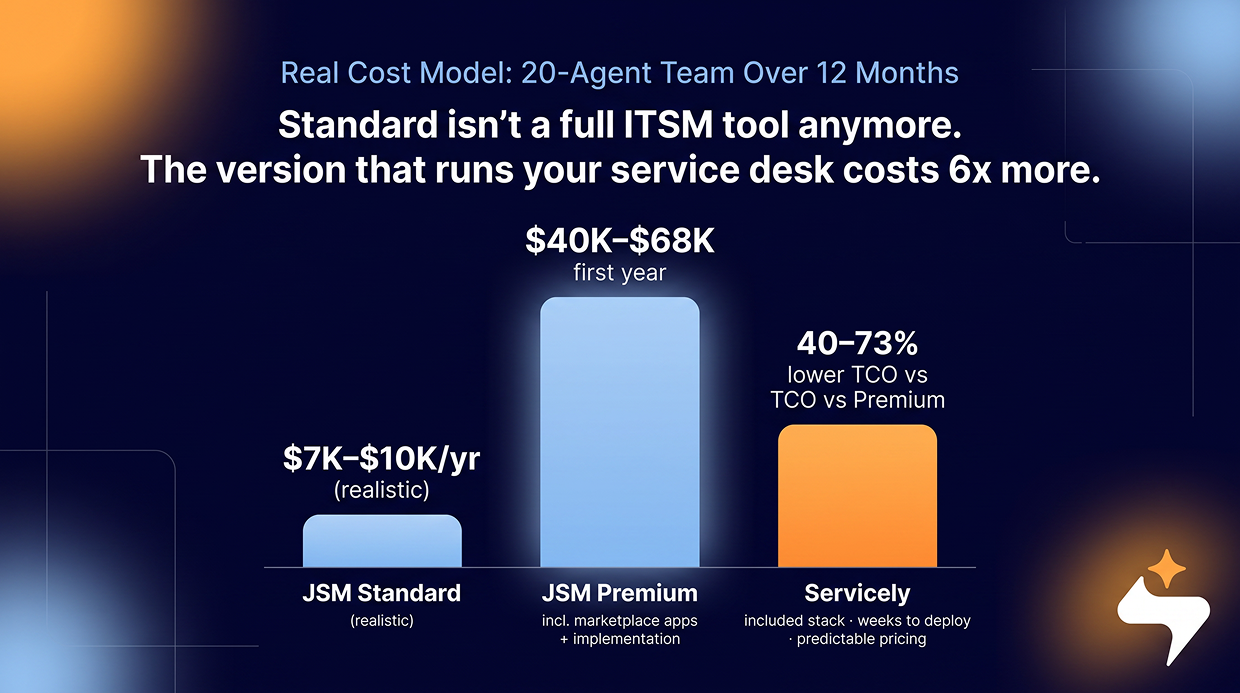
The point of this model is not to say JSM is expensive in absolute terms. At $20/agent, Standard is genuinely affordable. The issue is that, for a real ITSM operation, the $20/agent JSM Standard is no longer a complete product, not after October 2024. The tool that actually runs your service desk is the $51/agent version, and the total cost of that version over three years is a meaningfully different conversation.
Who Should Stay On Jira Service Management
If any of the following apply to your situation, JSM is probably the right call, and you should not let a competitor's blog post talk you out of it.
Your organization is Atlassian-native. If engineering runs on Jira Software, documentation lives in Confluence, and your developers are already fluent in the Atlassian ecosystem, the value of JSM's integration is real. Switching platforms means decoupling things that are currently connected. That is a cost that does not show up on a comparison chart.
You are a software company where IT and engineering are tightly coupled. DevOps integration, CI/CD change management, deployment tracking, and incident-to-code traceability are JSM's strongest use cases. If your service desk primarily manages developer infrastructure and software releases, JSM Premium is probably worth the price.
Your team has Jira administration expertise. JSM rewards teams with in-house Atlassian knowledge. If you have a dedicated Jira admin or a team comfortable with project configuration, the platform's flexibility becomes an asset rather than a liability.
You are already on JSM Standard, and your requirements are genuinely basic. If your team only needs incident management and request fulfillment, no change management, no CMDB, no problem workflows, JSM Standard at $20/agent/month is a fair price for what it does. Not every IT team needs the full ITIL stack.
If JSM Premium's price tag just changed your renewal conversation, let's talk. Servicely includes change management, problem management, AI-native automation, and ESM workflows, all in a single platform built for mid-market IT teams. No Marketplace add-ons required. No six-month implementation. We have helped teams cut platform costs by 40–73% while running a more capable service desk.
Book a 30-minute demo with our team
Who Should Seriously Evaluate Servicely
Servicely is not the right tool for everyone, and I am not going to pretend otherwise. But there is a specific profile where the comparison becomes compelling.
You are being pushed from JSM Standard to Premium by the 2024 packaging change. Your grace period is ending or has ended, and you are looking at an effective price increase of $30+ per agent per month to maintain the workflows you already depend on. That is a natural evaluation trigger.
You are a mid-market IT team that is not primarily managing software engineers. Your service desk handles employee IT support, hardware and asset management, change advisory processes, and increasingly, HR and facilities requests. You need an ITSM-first platform, not a developer tool that has been extended to handle service management.
You want AI that is part of the platform architecture, not bolted on. Servicely was built AI-native from the ground up. The virtual agent, intelligent routing, predictive assignment, and workflow automation are not features that were retrofitted; they are how the system operates under the covers. When we say 60% of requests are resolved via AI-assisted self-service, that number comes from how the platform was architected, not from an AI add-on running alongside the main product.
You need ESM expansion without a multi-year implementation project. If IT leadership is being asked to extend service management to HR, facilities, or finance in the next 12 months, Servicely ships pre-built workflows for those domains. You are not starting from a blank canvas and configuring your way to a solution.
You want predictable total cost of ownership. Servicely's licensing is transparent. The capabilities you need to run a proper service desk are included, not gated behind consumption billing or marketplace dependencies. For a mid-market IT director who has to justify spend to a CFO, predictability has real value.
The Honest Bottom Line
JSM is a well-built product with a strong ecosystem. If your organization is already in the Atlassian world and your IT team is closely tied to software engineering, it makes genuine sense.
But the October 2024 packaging change was a meaningful shift in the value equation for a specific type of customer: mid-market IT teams who were on Standard because it covered their needs, not because they were trying to save money on a Premium-grade product. Those teams are now being asked to pay significantly more for capabilities they were already using.
If that describes your situation, the right move is not to upgrade reflexively. The right move is to spend 30 minutes mapping your actual requirements against what each tier delivers, and then compare that against what alternatives can offer at the same or lower total cost.
That is exactly what our demo is designed to do. Not a product tour, but a structured requirements conversation where we figure out together whether Servicely is actually a better fit for your team or whether staying on JSM makes more sense.
Either outcome is useful. The one outcome that is not useful is signing another three-year contract because the renewal landed in your inbox and you did not have time to look at alternatives.
FAQs
Is Jira Service Management good for IT teams outside software development companies?
It depends on your organization's Atlassian footprint. JSM is strongest for IT teams embedded within software companies where engineers already use Jira Software and Confluence. For mid-market IT teams primarily supporting business users, not developers, the JSM interface and configuration model can create friction that purpose-built ITSM tools avoid. The question to ask is whether your IT team's workflows are naturally developer-centric or operations-centric.
How does Servicely compare to Jira Service Management on AI capabilities?
JSM's AI virtual service agent is a Premium-only feature with consumption-based pricing above 1,000 conversations per month. Servicely was built AI-native from the ground up; AI-driven routing, virtual agent, and workflow automation are part of the core platform architecture, not add-on modules. The practical difference is that AI in Servicely is woven into every workflow, whereas in JSM it operates alongside the main product. Customer outcomes from Servicely deployments show 60% of requests resolved via AI-assisted self-service, and 40% increases in service desk productivity.