.png)


Agentic AI and generative AI are not the same thing. The industry has spent the last two years using them interchangeably, which is a problem, because if you don't know which one you're actually buying, you're going to be disappointed when it arrives.
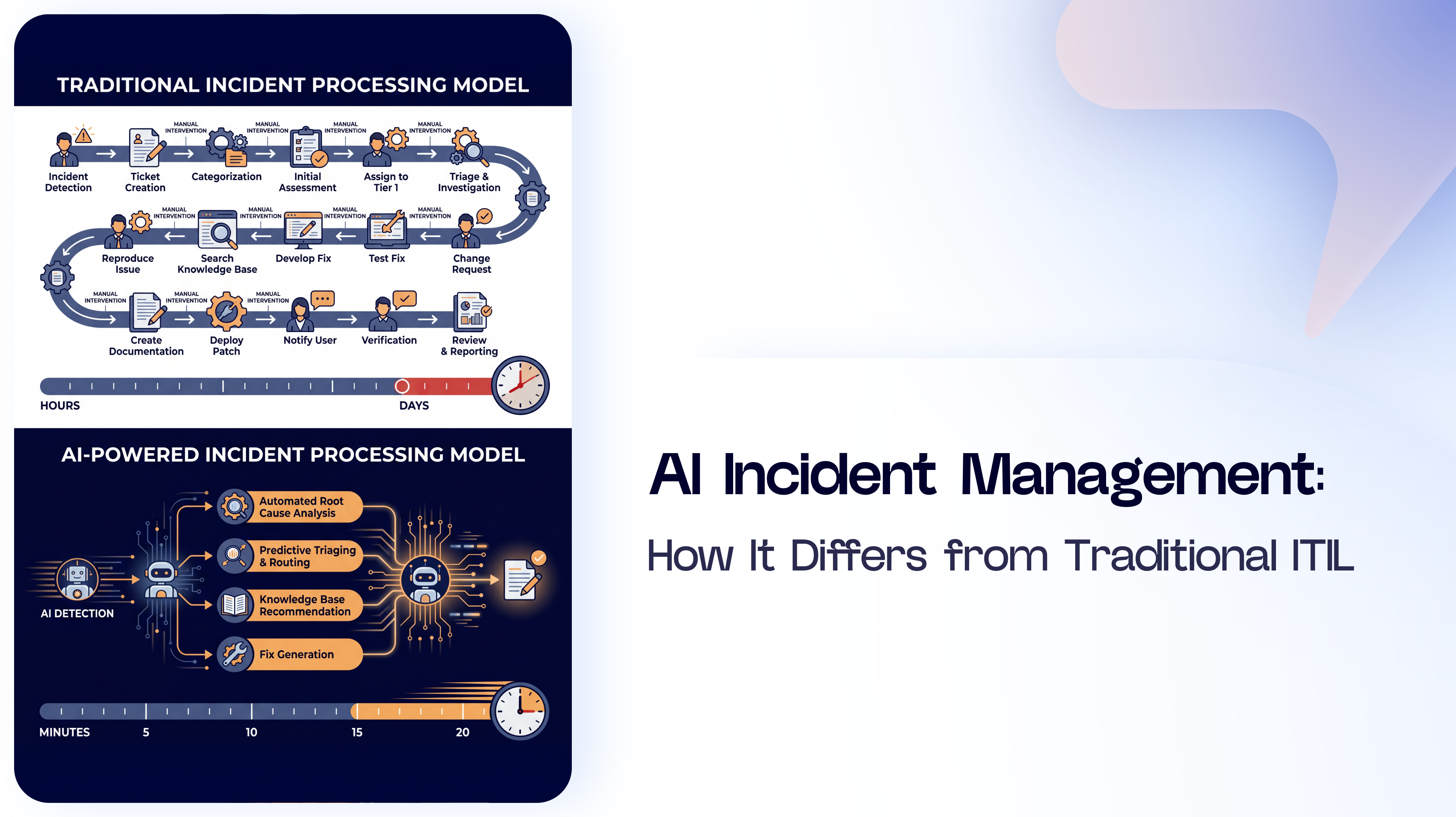
Here's the short version: generative AI produces content. It answers your question, drafts your summary, suggests the next step. Agentic AI takes action. It detects the problem, makes a decision, executes the fix, updates the records, and tells the user what happened, without anyone asking it to. In IT service management, that distinction separates a smarter chatbot from a system that actually closes tickets on its own.
This post breaks down what both technologies do, where each fits in an ITSM context, and why mid-market IT teams should care about which type of AI their platform is actually built on.
What Generative AI Actually Does in ITSM
Generative AI, the family of models that includes ChatGPT, Gemini, and Claude, learned to produce text, images, and structured data by training on enormous datasets. When you ask it a question, it generates a statistically likely and coherent response based on patterns in its training data.
In ITSM, that capability has been useful. Genuinely useful. Here's where it earns its keep:
- Ticket summarisation: A technician opens a three-day-old incident with 14 notes from four different people. Generative AI reads the thread and gives them a two-sentence brief.
- Knowledge article drafting: After a technician resolves an issue, the AI proposes a knowledge article based on the steps taken. The technician reviews, edits, and publishes.
- Response drafting: A user submits a vague "my laptop is slow" ticket. The AI drafts a clarification request and a suggested diagnostic checklist.
- Classification assistance: Generative AI reads an incoming ticket and suggests a category, priority, and routing, reducing manual triage time.
Notice the pattern: suggest, draft, propose, assist. Generative AI is fundamentally a co-pilot. It processes input and returns output. The human still has to read it, decide what to do, and take the action. That's not a criticism; it's a structural fact about how the technology works.
The limitation becomes clear the moment you ask what happens when the human steps away. Generative AI doesn't monitor your environment. It doesn't notice that a VPN endpoint has been failing for three hours. It doesn't decide, on its own, to restart a service, provision a replacement, and send the affected user a status update. It waits to be asked.
For many IT teams, that's fine. If your goal is to help technicians work faster and write better responses, generative AI delivers. But if your goal is to reduce ticket volume, cut after-hours escalations, and resolve incidents before users notice them, you need something that can act, not just advise.
What Agentic AI Actually Does in ITSM
Agentic AI is a different architecture, not just a more powerful version of generative AI. Where generative AI is prompt-and-response, agentic AI is goal-oriented. You give it an objective, or it infers one from observed conditions, and it figures out how to achieve it across multiple steps, systems, and decision points.
The four capabilities that define a genuinely agentic system in ITSM:
- Perception: It continuously monitors systems, logs, and signals. It doesn't wait for a ticket; it detects the condition that would have created a ticket.
- Reasoning: It correlates what it's seeing against known patterns, historical incidents, and its knowledge base to form a hypothesis about what's happening and why.
- Execution: It takes action. Restarts a service. Resets a credential. Provisions a replacement asset. Pushes a patch. Raises a change request. Not all of these happen without a human in the loop, but the agent manages the workflow, not a technician.
- Adaptation: If the first fix doesn't work, it doesn't just log a failure. It adjusts its approach, tries a different resolution path, and escalates only when it has exhausted its options or hit a threshold that requires human judgment.
The practical result is a different category of outcome. Generative AI helps your technicians resolve tickets faster. Agentic AI resolves tickets that never needed a technician in the first place.
Gartner predicts that agentic AI will autonomously resolve 80% of common customer service issues without human intervention by 2029. That's not a figure about chatbots getting smarter at suggesting answers. It's about systems that take the entire resolution workflow off the human's plate, from detection to fix to communication.
The Servicely ITSM platform is built on this architecture. The AI isn't bolted onto a legacy ticketing system as a feature. It's the operating layer that handles detection, triage, execution, and learning, with the ticketing system serving as the record, not the workflow.
The Real-World Difference: Three Scenarios
Abstract definitions only go so far. Here's what the difference between generative and agentic AI looks like in three situations your IT team faces every week.
Scenario 1: VPN outage at 2 am
With generative AI: No one's monitoring at 2 am. The VPN goes down. Users start submitting tickets at 7:30 am when they try to log in. A technician arrives, reads the spike in complaints, diagnoses the issue, and applies a fix by 9 am. Two hours of business disruption, 40 tickets in the queue.
With agentic AI: The system detects the VPN failure at 2:07 am. It compares it against previous incidents, identifies the root cause as an expired certificate, automatically renews it, validates the fix, and sends affected users a message that the issue has been resolved. Zero tickets. Zero human involvement. Zero business disruption.
Scenario 2: New employee onboarding
With generative AI: HR submits an onboarding request. The AI drafts a task list for the IT team. The technician still needs to provision accounts, configure access, set up the device, and verify everything, with AI helping draft communications along the way.
With agentic AI: The onboarding request triggers an agent that provisions the Active Directory account, assigns licenses in Microsoft 365, configures the device to policy, and sends the new employee their access details, all before the first day of work. The IT team reviews the completion log, not the task list.
Scenario 3: Recurring application crash
With generative AI: Ten tickets about the same application crash over two weeks. The AI summarises each ticket well and suggests possible causes. A senior technician eventually recognizes the pattern and investigates. The root cause is identified in week three.
With agentic AI: The pattern is detected on ticket three. The agent correlates the incidents, identifies a common trigger (a memory leak after a specific workflow), flags it as a problem record, proposes a remediation, and escalates to the change management process, all within the same week the pattern emerged.
The difference isn't a matter of degree. It's a difference in who's responsible for the resolution workflow: your team, or the system.
Want to see agentic AI close tickets, not just suggest fixes?
Servicely's AI-native ITSM platform resolves 60% of service requests without human involvement. We'll show you exactly how in a 30-minute session built around your current environment.
See Servicely's agentic AI in action
Why Mid-Market IT Teams Get Sold the Wrong Thing
Most ITSM vendors who claim "agentic AI" are selling you generative AI with a more aggressive marketing team. It's worth understanding how to tell the difference before you sign a contract.
A genuinely agentic system can answer yes to four questions:
- Does it monitor proactively? Not "can it respond to alerts"; does it detect conditions that haven't yet triggered a ticket?
- Can it execute actions across your systems? Not "does it have integrations"; will it use those integrations to take remediation steps on its own?
- Does it reason across multiple steps? Not "does it follow a workflow"; can it adapt its path when the first resolution approach doesn't work?
- Does it learn from what it does? Not "does it log outcomes"; does it update its resolution models based on what succeeded and what failed?
Most "AI-powered" ITSM tools you'll see demoed score well on question one (alerting is well understood), reasonably on question two (integrations exist, even if the agent doesn't use them autonomously), and poorly on questions three and four. They can trigger a pre-built workflow. They can't adapt when the workflow hits an edge case.
ServiceNow has the resources to build genuine agentic capabilities. The problem for mid-market IT teams isn't their technology; it's that deploying ServiceNow's agentic features requires a consultant engagement that costs more than most mid-market ITSM budgets for a full year. You end up paying for enterprise AI and getting a partially configured system that takes months to tune.
Freshservice and HaloITSM are in a different position. They've added generative AI features, summarisation, suggested responses, and drafting assistance, but their underlying architecture is still ticket-queue-based. The AI assists the workflow; it doesn't replace it.
The mid-market case for AI-native ITSM isn't about having the most sophisticated AI on the market. It's about having a platform where AI handles the routine resolution load so your IT team can focus on work that actually requires their expertise. That's a different design goal than bolting a ChatGPT integration onto a ticketing system built in 2012.
How SoFi Makes Agentic AI Practical for IT Teams
Servicely's System of Intelligence, SoFi, is the layer that makes agentic AI operational rather than theoretical. It's not a chatbot. It's not a feature. It's the decision-making architecture that sits underneath every interaction in the platform.
SoFi operates across three modes depending on what's needed:
Assistants handle conversational, multi-turn interactions, with the technician asking "what's the current status of this incident and what are the next steps?" and receiving a context-aware, actionable answer. Not a template. Not a keyword match. An actual synthesis of the incident history, the CMDB, the knowledge base, and the current system state.
Agents are the autonomous backend workers. When an incident comes in, agents handle the triage, routing, enrichment, and, where the resolution is deterministic: the fix itself. Auto-resolving up to 75% of incidents with confidence before a ticket is ever raised means the queue your technicians see is already filtered down to the work that actually requires human judgment.
Prompts and Tools are the single-turn operations that run underneath everything else: classification, categorization, validation, data quality checks, integration calls. These aren't visible to the end user, but they're what allow the agents to act reliably across your connected systems without creating new data quality problems.
The practical result is a service desk that handles its own L1 load and much of what your team currently treats as L2, without expanding headcount. Service desk automation isn't new, but automation that adapts in real time to what's actually happening in your environment is a different proposition from rule-based workflows that break every time your environment changes.
For IT Directors managing teams of five to twenty people with enterprise-scale environments, that distinction matters. You can't automate your way out of a constantly changing environment with static rules. You need a system that updates its own understanding of what "normal" looks like and adjusts its response accordingly.
Servicely also supports bring-your-own-LLM, OpenAI, Azure OpenAI, and Anthropic, so the AI layer can be configured to match your data sovereignty requirements. For organizations in regulated industries or with strict data residency obligations, that flexibility isn't optional.
What Agentic AI Can't Do Yet
Every article on this topic oversells autonomy and undersells the boundaries. Here's an honest account of where agentic AI in ITSM has real limits today.
Novel incidents: Agentic AI is effective when it has pattern data to work from. For truly novel incidents, new infrastructure failures, previously unseen error codes, and complex interactions between recently deployed systems, the agent's ability to reason toward a solution degrades. Human escalation is still the right call. The best agentic systems know when they're outside their confidence threshold and route accordingly. The worst ones try to resolve anyway.
High-risk changes: An agent can identify that a configuration change would fix an infrastructure problem. Whether that change should happen autonomously depends entirely on your change management policy. Agentic AI should not be making unilateral decisions about production infrastructure changes; it should be drafting the change request, populating the risk assessment, and routing it for human approval. Any vendor who tells you their AI can handle prod changes without guardrails is selling you risk, not capability.
Ambiguous user requests: "My computer isn't working" is not a well-formed task for an autonomous agent. Natural language interpretation has improved dramatically, but agentic AI still performs significantly better when requests are specific. Self-service portals that guide users toward structured inputs, not open-text boxes, still produce higher automation rates than "just ask SoFi anything."
Organizational change: The technology can be deployed in weeks. Getting IT staff to trust it enough to let it act autonomously, and getting users to expect it to act autonomously, take longer. Agentic AI adoption is as much a change management challenge as a technical one. Teams that treat it as a product deployment and skip the change management work typically see lower automation rates than teams that invest in the transition.
Acknowledging these limits isn't a concession; it's what separates a credible product position from vendor marketing. Servicely's agentic AI is built with configurable autonomy thresholds for exactly this reason. You decide what the agent handles autonomously, what it handles with notification, and what requires approval before action.
The Business Case: What Agentic AI Actually Changes About ITSM Economics
The ROI conversation around AI in ITSM has been muddied by vendor claims that are long on percentages and short on methodology. Let me give you a framework that's honest about where the value comes from and where it doesn't.
Where the value is real:
L1 automation. The average enterprise IT service desk spends 40-60% of its ticket volume on L1 requests, password resets, software installs, access provisioning, and basic troubleshooting. These are deterministic, repeatable tasks. Agentic AI can handle most of them without human involvement. Servicely customers see 60% of service requests resolved via AI self-service and automation; that's not a theoretical number, it's what happens when the automation is actually architected into the platform rather than layered on top.
Resolution speed. When an agent handles an L1 ticket autonomously, resolution time is measured in seconds, not hours. For the requests that do involve a technician, AI-assisted triage and enrichment mean the technician arrives at the problem with context already assembled. Servicely customers report 300% faster resolution times, a figure that reflects both fully automated resolutions and AI-augmented human resolutions.
Service desk productivity. If 60% of tickets are handled autonomously, and the remaining 40% reach technicians already triaged and enriched, the same team can handle significantly higher volume without adding headcount. For mid-market IT teams under pressure to do more with flat or shrinking budgets, that's the material value proposition. A 40% increase in service desk productivity is the outcome, not the pitch.
Where the value is overstated:
Proactive prevention is real, but it requires a mature CMDB and good observability data. If your configuration management is in poor shape, your agent doesn't have the context it needs to reason accurately about incident causation. The promise of "preventing incidents before they happen" is genuine for teams with good data foundations. For teams with configuration debt, it's a reason to invest in CMDB quality first.
Cost reduction claims often obscure the real picture. Agentic AI reduces the labor cost per ticket resolved. It does not necessarily reduce overall IT headcount; in most mid-market organizations, what it does is free up the team to work on higher-value projects that were previously deprioritized because the service desk was consuming everyone's time. That's valuable. It's not the same as headcount reduction.
The agentic AI use cases in enterprise service management that deliver the fastest ROI are those with the highest volume and the most deterministic resolution paths. Start there. Build from there. Don't try to automate your most complex incidents first.
Your IT team shouldn't be managing tickets. They should be managing outcomes.
Servicely is the only AI-native ITSM platform built specifically for mid-market IT teams who want enterprise-grade automation without the ServiceNow implementation bill. See it working in your environment, not a generic sandbox, in 30 minutes.
Book a personalized Servicely demo