.png)


Freshservice is a genuinely good product. If you are a 50-person company running a basic IT ticketing queue, it is probably the right call. Freshworks has built something polished, accessible, and well-supported, and it deserves credit for that.
But here is the problem: many mid-market IT teams buy Freshservice at the Growth or Pro tier, get comfortable, and then hit a wall around year 2. The service desk is humming. The ticket volumes are climbing. Leadership is asking why more requests are not being resolved without human hands. Someone on the team suggests turning on the AI features, and that is when the conversation gets complicated.
The autonomous AI Agent in Freshservice, the capability that deflects tickets before they reach an agent, is locked behind the Enterprise plan. The Freddy AI Copilot, which helps agents write faster, costs an extra $29 per agent per month on top of your base plan. And you cannot bring your own LLM. You use Freshworks' model selection, on Freshworks' timeline, at Freshworks' price point.
This post lays out exactly what each platform does, what it costs at realistic mid-market scale, and who should be on which platform. I’ve spent the last several years building for the gap that Freshservice leaves behind.
What Freshservice Gets Right
Before getting into the trade-offs, it is worth being honest about where Freshservice is strong, because it is strong in places that genuinely matter.
The onboarding experience is fast. Most mid-market IT teams can have a working ticketing environment in days, not months. The interface is clean and intuitive enough that agents pick it up without extensive training. The ITIL-aligned feature set- incident, problem, change, release management- is solid across the Pro and Enterprise tiers. The asset management and CMDB capabilities are credible for teams that need visibility into their infrastructure without the complexity of a full ServiceNow deployment.
Freshservice also has a mature integration ecosystem. If your team is already running in the Freshworks suite- Freshdesk for customer support, Freshsales for CRM- there is an argument for consolidation. The reporting and analytics tooling at the Pro tier is better than most tools at the same price point. And Freshservice's knowledge base functionality is genuinely usable, which is more than can be said for several competitors.
For IT teams that need a structured, process-oriented ITSM tool with good vendor support and a predictable roadmap, Freshservice is a reasonable choice. The issue is not that Freshservice is bad. The issue is who it is designed to grow with, and what it costs when you actually want the AI layer to do meaningful work.
The Freddy AI Tier Problem: What You Actually Get and When
Freshservice markets itself as an AI-powered ITSM platform. That claim is accurate, but the timeline for accessing that AI depends heavily on which plan you are on, and the tier wall is steeper than most buyers realize before they sign.
Here is how the AI capabilities actually break down across plans:
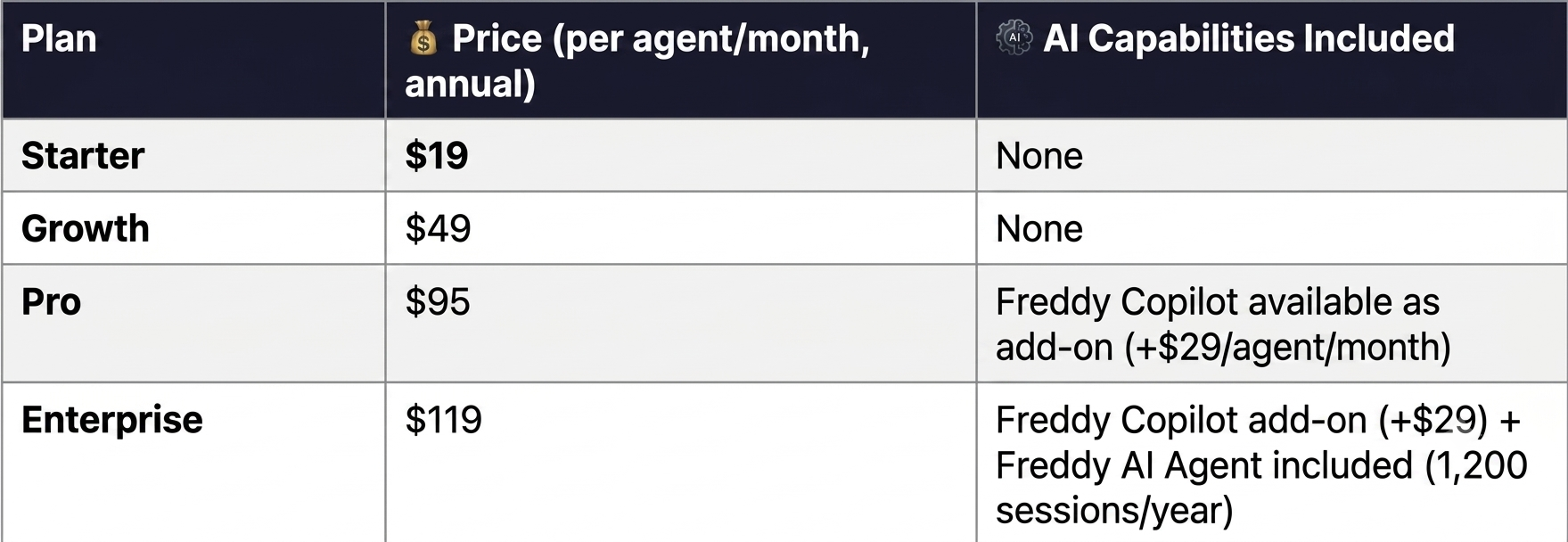
The distinction between Freddy Copilot and Freddy AI Agent is important. Freddy Copilot is an assistant for your human agents; it summarizes tickets, suggests replies, helps with tone, and detects similar tickets. It makes your agents faster. That is valuable, but it is not autonomous resolution. You still need a human agent to close the loop.
Freddy AI Agent is the autonomous layer, the capability that intercepts a request before it becomes a ticket, resolves it without human involvement, and deflects volume at scale. That is what most IT leaders are actually asking for when they say they want AI in their service desk. And that capability is exclusive to the Enterprise plan, with a cap of 1,200 sessions per year included in the base Enterprise license. Once you exceed that allocation, overage charges apply.
A session, per Freshservice's own documentation, is counted when a unique user interacts with the AI Agent within a 24-hour window. For a 500-person company where IT support is actively used, 1,200 sessions per year is roughly 100 sessions per month, or about 20 percent of your employee base using the AI once a month. That ceiling gets tight quickly.
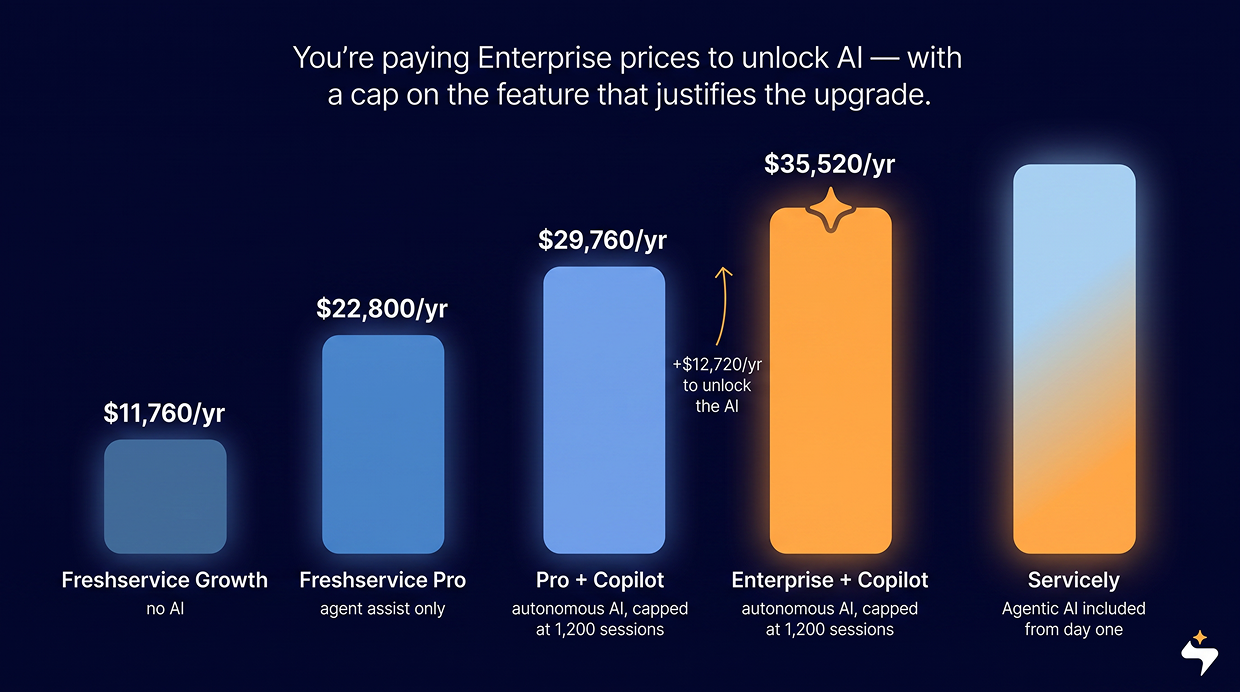
The practical implication: if you are on the Pro plan and you want the AI to do meaningful autonomous work, you need to upgrade to Enterprise and add Freddy Copilot on top. That changes the cost model significantly.
Want AI that resolves tickets without a tier upgrade?
Servicely's agentic AI is built into the platform, not gated behind an Enterprise upsell. See how it handles autonomous resolution in a live environment with your actual service desk scenarios.
See Servicely's agentic AI in action
The Real Cost Model: What 20 Agents Actually Pay
Abstract per-agent pricing does not tell the full story. Here is what a team of 20 IT agents actually pays across Freshservice's tiers versus Servicely, including the add-ons required to unlock meaningful AI functionality.
or most teams, this is fine today. But the LLM landscape is moving faster than any single vendor's roadmap. OpenAI, Anthropic, Google, and open-source models are producing meaningful capability improvements on timescales of months, not years. An organization locked into a single vendor's model selection is betting that the vendor will keep pace and accepting whatever trade-offs the vendor makes regarding cost, model choice, and feature rollout priorities.
Servicely takes the opposite architectural position. The platform supports Bring Your Own LLM; organizations can run OpenAI, Azure OpenAI, Anthropic, or other models against their service desk environment. That means you can adopt better models as they release without waiting for a platform vendor to integrate them. It also means you retain control over data decisions: which data leaves your environment, to which model provider, and under what terms.
This is not a minor architectural footnote. For IT leaders in regulated industries, financial services, healthcare, and government-adjacent sectors, LLM data routing matters. And for any organization that expects to be running this platform in 2027 or 2028, vendor model lock-in is a compounding risk.
Feature Comparison: Servicely Vs. Freshservice Side by Side
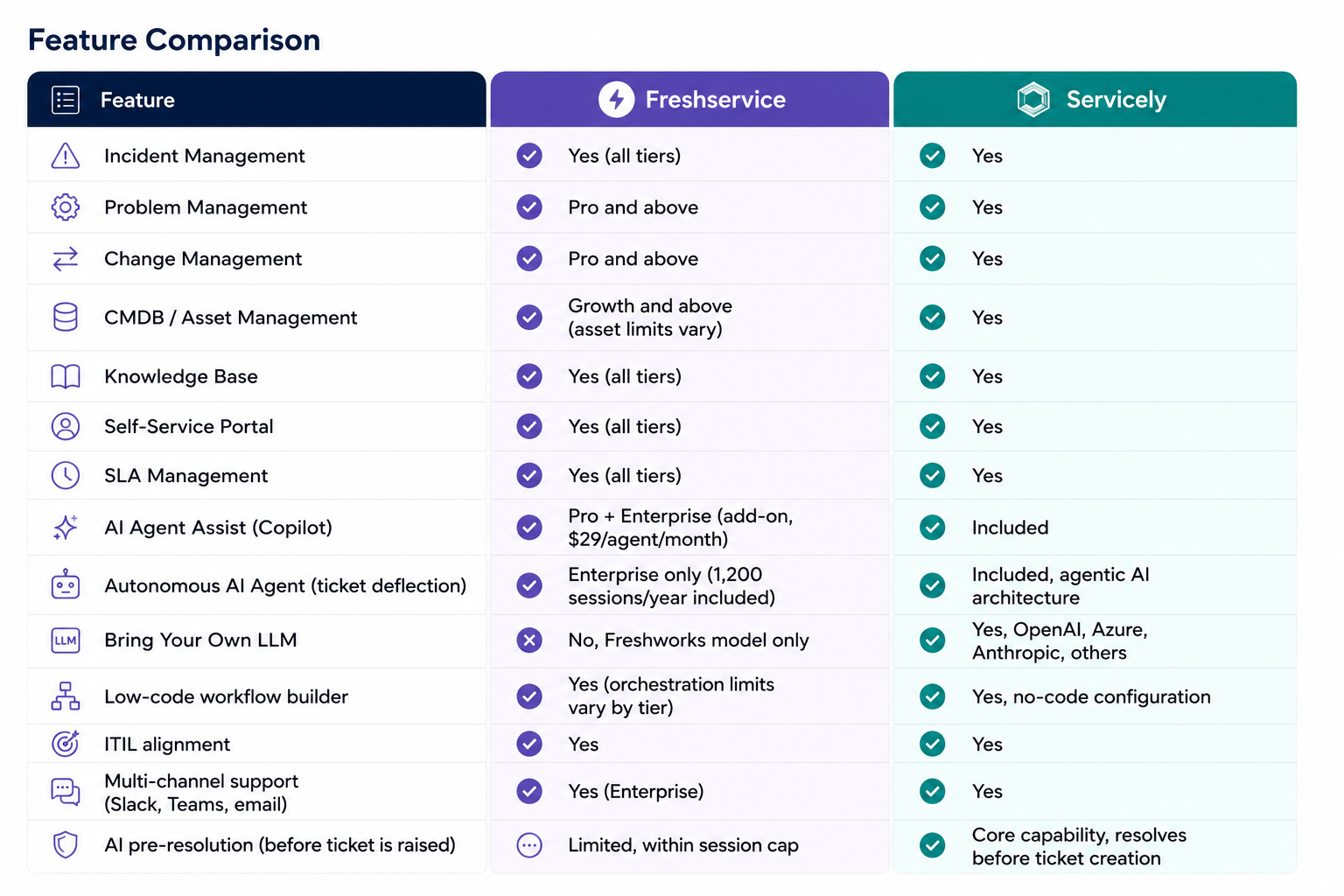
The core difference is architectural: Freshservice built a strong ticketing platform and layered AI on top as a monetizable add-on tier. Servicely was designed from the ground up with agentic AI as the operational core; the platform is built around the premise that most tickets should never reach a human agent. That design decision flows through everything: the pricing model, the feature set, and the direction of the product roadmap.
Who Freshservice Is Right For
Freshservice is the right platform for your team if the following conditions are true:
You are running a structured ITSM environment where ITIL process compliance is the primary goal, and you have no near-term pressure to drive autonomous ticket deflection at scale. Your team values polish, a mature vendor relationship, and an established integration ecosystem over architectural flexibility. You are comfortable with the Freshworks model selection and have no regulatory requirement to control LLM data routing. You are on the Enterprise tier already, or you have a clear line of sight to Enterprise within the next budget cycle, and the session limits on Freddy AI Agent fit your volume profile.
If you are a 100-person company running 10 IT agents, not yet under pressure from leadership on AI ROI, and happy with a solid ticketing system that will grow with you, Freshservice at the Pro tier is a credible, defensible choice.
If your Freshworks account executive is proposing an upgrade to Enterprise primarily because you want the AI Agent to do meaningful deflection work, that is when it makes sense to run the full cost model and compare alternatives before signing.
Who Servicely Is Right For
Servicely is built specifically for mid-market IT teams, companies with 500 to 5,000 employees, who need enterprise-grade ITSM without the enterprise price architecture that buries the AI capabilities in the highest tier.
The platform makes sense when you are facing one or more of these situations: your IT team is handling more volume than headcount can absorb and you need autonomous resolution to move the needle, not just faster humans; you are evaluating whether to upgrade Freshservice to Enterprise and the math does not feel right for what you are getting; you are in a regulated industry where LLM data routing decisions need to stay in your control; your leadership is asking for 50 to 60 percent ticket deflection via AI and your current platform cannot credibly deliver that number without a substantial investment; or you are building out an IT service management function that needs to scale over the next three to five years without being repriced every time you want to use the features you originally bought for.
Servicely is also purpose-built for teams that do not want to depend on consultants or professional services to configure workflows. The no-code workflow builder is designed so that IT administrators, not implementation partners, can configure automation in natural language. If you have ever paid a Freshworks partner to build a workflow that your team should have been able to build in an afternoon, that design philosophy matters.
Your IT team deserves AI that works on day one, not after an Enterprise upgrade.
Servicely was built for mid-market IT teams who need autonomous ticket resolution without the tier wall. If you are evaluating your next ITSM platform or re-assessing your Freshservice renewal, see how Servicely handles your actual service desk scenarios in a 30-minute personalized demo.
FAQs
How does Servicely's AI architecture differ from Freshservice?
Servicely was designed from the ground up as an agentic AI platform; the autonomous resolution capability is architectural, not a tier add-on. The platform supports Bring Your Own LLM, meaning organizations can run OpenAI, Azure OpenAI, Anthropic, or other models against their service desk without being locked to a single vendor's model selection. Servicely's architecture is built around entirely preempting ticket creation, with reported metrics showing it resolves up to 75 percent of incidents before a ticket is raised.
Who is Servicely built for compared to Freshservice?
Servicely is designed specifically for mid-market IT teams, companies with 500 to 5,000 employees, who need autonomous AI ticket resolution without the Enterprise tier requirement. Freshservice is a strong fit for teams prioritizing ITIL process structure, a mature vendor ecosystem, and those that have either reached the Enterprise tier or do not yet have autonomous AI deflection as a primary goal. The core decision point is whether you need the AI to do real autonomous work now, or whether agent-assist tooling is sufficient for your current stage.
What is the difference between Freshservice Pro and Enterprise for AI?
The Pro plan includes no AI capabilities by default. Adding Freddy Copilot costs $29 per agent per month on top of the $95 base, but Copilot only assists human agents; it does not resolve tickets autonomously. The Enterprise plan at $119 per agent per month includes the Freddy AI Agent (1,200 sessions/year) but still requires the separate Copilot add-on for agent assist features. The full AI stack on Enterprise runs approximately $148 per agent per month before any overage.
Can I bring my own LLM to Freshservice?
No. Freshservice AI capabilities run on Freshworks' own model infrastructure. You cannot select or swap the underlying LLM that powers Freddy AI. If LLM data routing decisions, model selection, or vendor flexibility matter for your compliance posture or technology strategy, this is a meaningful architectural constraint to evaluate before committing to the platform long-term.
How many Freddy AI Agent sessions does the Enterprise plan include?
Freshservice Enterprise includes 1,200 Freddy AI Agent sessions per year in the base plan. A session is counted when a unique user interacts with the AI Agent within a 24-hour window. Overage charges apply when usage exceeds the annual allocation. For organizations with active employee IT usage, 1,200 sessions per year equate to roughly 100 interactions per month across your workforce, which can become a constraint at scale.
Is Freshservice's Freddy AI available on all plans?
No. Freddy AI Copilot, the assistant that helps agents write faster and summarize tickets, is available as a paid add-on on the Pro and Enterprise plans at $29 per agent per month. Freddy AI Agent, the autonomous capability that resolves tickets without human involvement, is available exclusively on the Enterprise plan. Customers on the Starter or Growth tier have no access to AI features. Customers on the Pro tier can add Copilot but cannot access autonomous ticket deflection regardless of add-on spend.